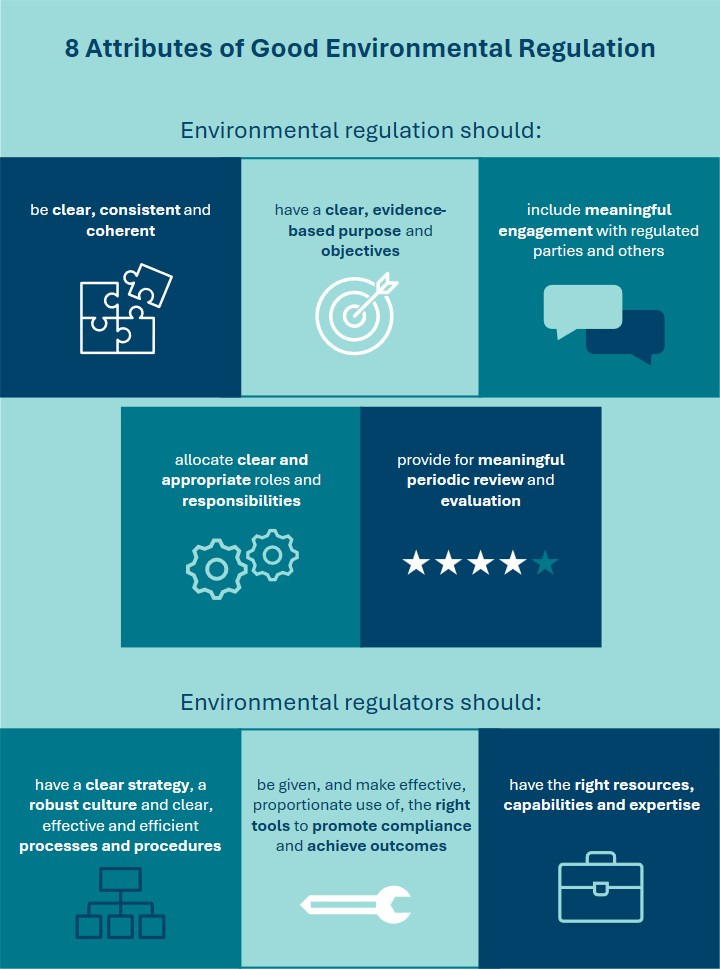
What makes for good environmental regulation?
Environmental regulation plays a crucial role in protecting the environment and human health from harm, and in safeguarding natural resources that underpin people’s wellbeing and society’s economic prosperity.
Regulation that is based on a clear evidence base, well-designed and effectively implemented can deliver environmental outcomes in an efficient way, as well as fostering innovation, investment and new business models. Environmental regulation can also help to create a level playing field for businesses, and to support the achievement of government’s wider, legally binding targets and other commitments.
We use the term ‘environmental regulation’ to refer to environmental laws and their implementation which are intended to get people or organisations to act (or refrain from acting) in ways they may not otherwise choose, for the purpose of environmental protection or improvement.
We have identified eight high-level attributes of good regulatory design and implementation. They are the synthesis of our previous work, framed in a form designed to support our own functions and considered in conjunction with the principles that have been developed through work by others on the topic. These attributes will be used to guide the OEP’s assessments and evaluation of the implementation of existing environmental law. They may also inform our analysis of proposed changes to laws for environmental regulation.
Environmental regulation should have a clear, evidence-based purpose and objectives, linked to achieving a significant environmental improvement
The purpose of a piece of intended legislation provides a fundamental starting point for its design, and justification for a regulatory intervention in the first place. It should also inform the approach to implementation where choices are available, so that the regime is applied in a purposeful way.
It needs to be clear what a system of environmental regulation is intended to achieve in terms of all types of outcomes with clear paths to achieving those outcomes. If a regime does not have this it may be poorly designed and ineffective and provide inappropriate solutions to the issue in hand.
Environmental regulation should allocate clear and appropriate roles and responsibilities, linked to delivering a significant environmental improvement
Clarity of roles and responsibilities are a key feature of building good governance and certainty into regulatory design. Environmental regulation should ensure that regulators are clearly identified so that they can be accountable for the delivery, efficiency and effectiveness of their activities and the achievement of the intended outcomes.
The National Audit Office (NAO) highlights further benefits which can flow from clear roles and responsibilities, including enabling regulators to be aware of the responsibilities of the wider regulatory system, which can promote collaboration and alignment in working.
Environmental regulators should be given, and make effective, proportionate use of, the right tools to promote compliance and achieve outcomes
The relevant regulator should be accountable for delivering the intended outcomes, and that those outcomes should be realistic and achievable. In order to do this, the regulator needs to be given the tools that enable it to realise this, and to use them effectively to do so. This will include tools to support compliance, to monitor compliance and, where necessary, to respond to non-compliance including through enforcement action. The consequences of compliance or non-compliance should be considered from the outset, and enforcement planning should go hand-in-hand with the design of mechanisms to support and monitor compliance.
Environmental regulators should have the right resources, capabilities and expertise
For effective environmental regulation, the regulator must have sufficient staffing and resources, and reliable funding mechanisms. These factors make a significant contribution to regulatory compliance and promoting understanding of environmental obligations.
Environmental regulation should include meaningful engagement with regulated parties and others
Engagement with relevant parties is an important element in the design and implementation of environmental regulation, supporting transparency, accountability and informed decision-making. It can take many forms, including public consultations, calls for evidence, working groups and advisory councils, the presentation of draft legislation for pre-legislative scrutiny, and targeted discussions with specific parties on particular issues.
Environmental regulators should have a clear strategy, a robust culture and clear, effective and efficient processes and procedures
This covers how regulators function in implementing environmental regulation, regardless of their specific roles, resources and tools. Their strategy, culture and operational procedures may be common to several regimes, or they may differ from one to another depending on an organisation’s structure and approach.
Environmental regulation should provide for meaningful periodic review and evaluation
Review and evaluation are important and usually involve an analysis of whether an intervention is working as planned, how the regulatory system is operating in practice and why the regulation is working as it is. Evaluation may also assess whether environmental changes can be attributed to the regime.
Environmental regulation should be clear, consistent and coherent
There should be clarity over environmental regulatory regimes and how they fit within the wider body of environmental law and policy. Much of the current body of environmental law is fragmented, complex and difficult to understand. This can create a barrier to effective implementation, especially where regulated parties are left struggling to interpret what specific legal provisions require of them.